
Guardian Solutions helps Richmond businesses plan ongoing organic SEO around the services they actually sell. A searcher seeking printing from a supplied model needs a different service explanation from someone seeking design help. Make that distinction clear before the quote form, and agree how inquiries for each supported service will be assessed as qualified opportunities. Website intake changes support that work but require their own implementation scope.
We are based in Colorado Springs and work with national clients remotely over Zoom, not from a Richmond office. Request a free website and SEO audit and 30-minute consultation to discuss the service page and the kinds of qualified inquiries you want. The audit has no purchase obligation.
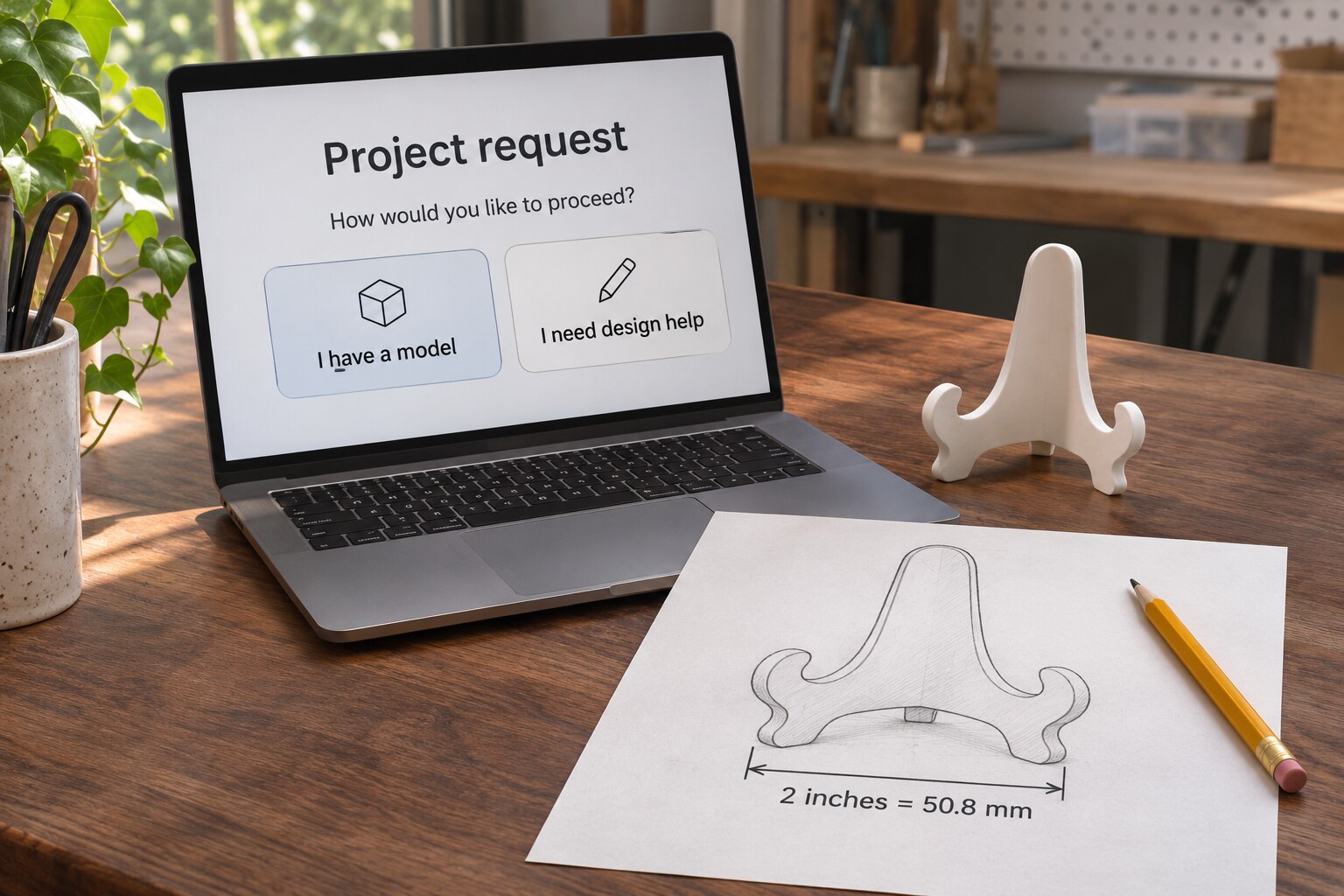
Richmond customers can arrive with different starting points
Richmond’s 3D Central describes design and fabrication work as well as printing. Its custom request page asks for project details such as size and quantity and accepts an existing design file. Those are useful distinctions for service content: a finished model and an idea that needs design work are not the same request.
These public offerings establish a local use case, not a claim that 3D Central is a Guardian client or that its form has a problem. Before choosing the next content assignment, list the starting points your business genuinely accepts.
Explain the two services before asking for a file
Consider a fictional Richmond display-maker requesting twelve small decorative stands. One customer already has a model and wants the supplier to assess it for printing. Another has a sketch and needs help developing the design. These are illustrative planning examples, not actual customer inquiries.
For a supplier that accepts both, the content needs to explain what each service does and where the customer starts. The supplied-model explanation can describe the assessment step; the design-help explanation can welcome an unfinished idea within the business’s actual scope. Requiring a completed CAD file as the only next step would contradict an offer of design assistance.
Turn those starting points into the next organic SEO assignment
For the fictional supplier, review the existing service page before commissioning more articles. Does it explain printing from a supplied model separately from design assistance? Can a prospect tell which service accepts an unfinished idea and which expects a usable design? Add the missing owner-approved explanation and link each supported service to the appropriate inquiry route.
A short comparison may answer both needs on one page. Create a separate design-help destination only when the business has enough distinct service information to make it useful. Do not duplicate the same printing offer under new headings or imply that every file is ready for production. The decorative-stand example above supplies a concrete question the content can resolve: does the customer need help developing the design or want the existing model assessed?
At the agreed review, compare the organic page and query evidence actually available with aggregated inquiry reasons. Separate supplied-model prospects, design-help prospects and requests outside the company’s offer. A file upload is not automatically a qualified opportunity, and an unresolved manufacturing decision should stay unresolved in the report.
Use those findings to choose the next service explanation or internal link to improve. If the explanation is already clear but staff cannot retrieve an attachment, retain the good content and assess that technical failure separately. More SEO copy would not repair the handoff.
An existing model still needs the supplier’s assessment
Keep one important distinction in that service explanation: a model file is not a complete production specification. Shapr3D’s STL units explanation notes that STL transfers unitless mesh geometry. For the fictional stand, an intended width of 2 inches (50.8 mm) is not a numeric width of 2 interpreted as millimeters. The supplier must resolve the intended scale and assess suitability; Guardian does not provide CAD, engineering or manufacturing approval.
Keep necessary form work separate from the SEO assignment
If an actual form problem prevents the supported inquiry, agree a separate implementation brief: accepted formats and size limits, the project information staff need with the file, and a test using authorized nonconfidential samples. Successful receipt is not a final quote or production approval. A protected file portal or automated pricing system is a different scope, not an assumed part of service-content work.
Guardian’s Joomla support, WordPress support or website design work depends on the existing installation and the change required. Retain useful content when the problem is functional; adding another service article cannot repair a failed attachment.
Look at the work behind the proposal
Guardian’s Add All Electric case study discusses website and search work for a Dallas–Fort Worth contractor. It is an example to review when comparing Guardian’s approach, not evidence of CAD validation, manufacturing software or a Richmond client result. Use that context to discuss the agreed service-content and search work, not as proof of specialist manufacturing capabilities.
To start, send the service-page address, the two request types your business actually accepts and anonymized questions prospects still ask. Do not include confidential models or passwords in the first inquiry. Discuss organic SEO for your actual technical services or request the free website review.
Questions about technical-service content and recurring SEO
What should distinguish supplied-model work from design assistance?
Explain what each service helps a customer accomplish and what starting information the business accepts. Link those explanations to the supported inquiry route. The request should preserve that choice rather than leave staff to infer it from a filename, and the page must not invent a design service simply to complete a comparison.
Do printing and design assistance each need a new SEO page?
Not automatically. A clear comparison on the existing service page may answer both questions. A separate page needs substantial distinct information about a genuine service and a useful connection to the rest of the site. Choose that investment from the unanswered customer need rather than a page quota.
How should recurring SEO reporting classify technical inquiries?
Distinguish supplied-model work, design assistance and requests outside the actual offer, using the business’s qualification criteria. Review available organic source evidence separately. An uploaded file or received form does not establish technical feasibility, an accepted job or a sale caused by SEO.
Must service-content improvements wait for a new quote form?
Not when the existing inquiry route can support the real offer. Clarify the services and useful links first. If a demonstrated form problem prevents an appropriate inquiry, assess it separately rather than disguising implementation work as another content assignment. Automated pricing and protected file portals need their own scope.
Does a successful upload establish that a design can be manufactured?
No. It establishes neither technical suitability nor production acceptance. A qualified manufacturer must assess the model, scale, material and other relevant requirements. The website’s confirmation should describe receipt for review, not an engineering approval or a final quote.