
Connect your Duluth marketing to a useful next step
Attracting visitors and handling their inquiries are related, but they are not the same assignment. Guardian Solutions helps Duluth businesses improve organic visibility, explain their services and make website contact paths easier to use. We provide SEO, digital marketing planning and website services remotely from Colorado Springs.
Make it easier for the right customer to inquire
We can review whether your service pages describe suitable projects, answer common buying questions and guide visitors to the relevant contact option. Ongoing SEO can strengthen useful content, internal links and technical foundations. Website design can address navigation and mobile presentation without adding unnecessary steps.
The follow-up example below deals with what happens after an inquiry arrives. It is one operational consideration, not a requirement to replace your existing tools. Any CRM connection or automation needs a defined scope and a clear owner within your business.
Discuss your Duluth website and marketing goals. We can separate the work needed to attract appropriate inquiries from the process your team uses to respond.
For a Duluth business connecting its website to a CRM, decide who will run the inquiry list after setup. A customer can accept an estimate by phone while the system still has a reminder queued. The useful integration is one your team can keep accurate: someone owns the next action, records the conversation and checks that outdated follow-up has stopped.
Discuss your website’s inquiry process with Guardian. We work with Duluth businesses remotely from Colorado Springs, with consultations over Zoom. Website forms, integration requirements and responsibilities can be assessed before a scope is agreed. This does not include a staffed sales desk or a promise to operate your CRM.
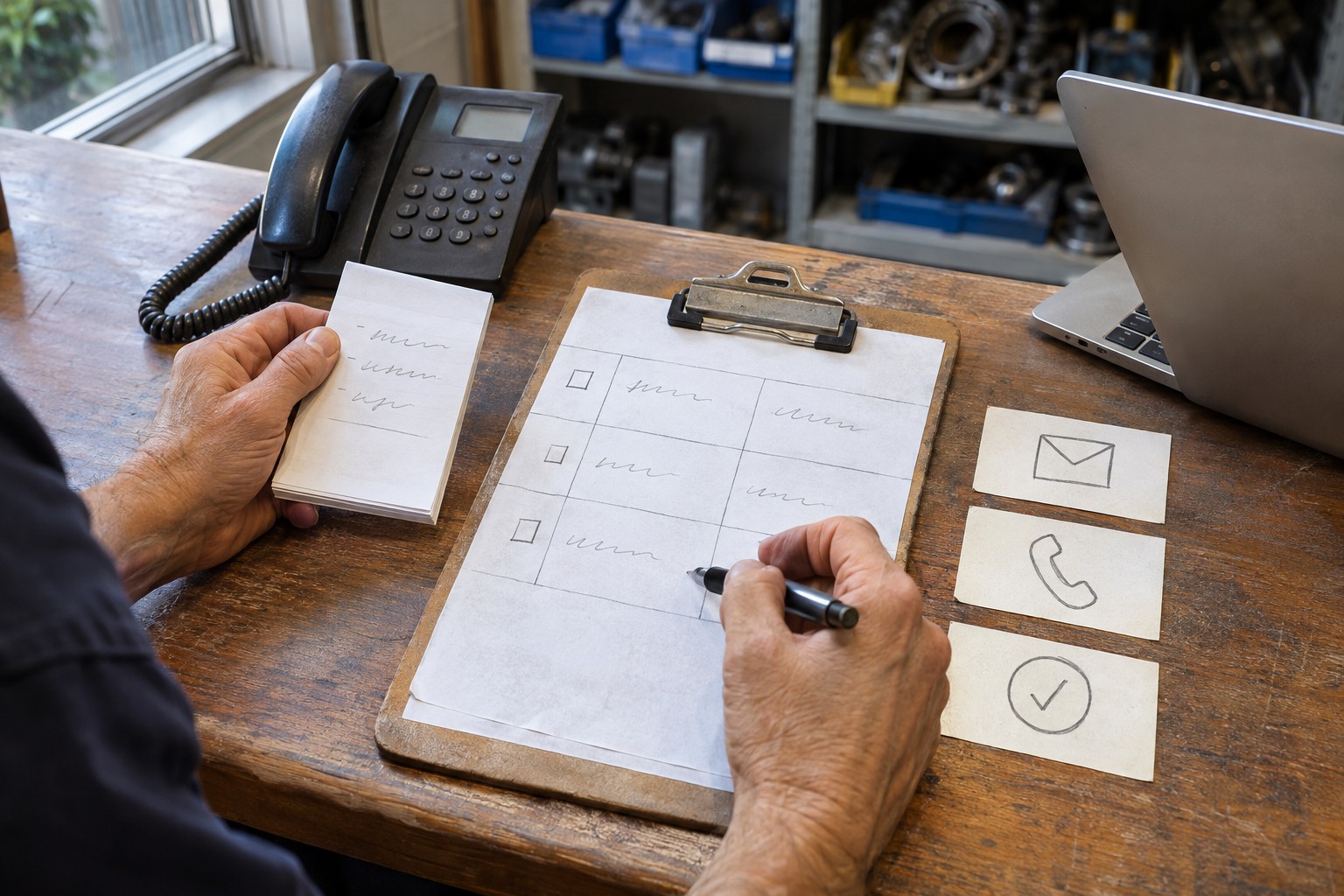
Plan the website connection and the follow-up responsibilities
Guardian can help clarify how your website attracts inquiries and what a visitor should do next. A useful project scope identifies the pages, forms and integration requirements separately from the software subscription and the daily work of answering customers.
Before connecting a form to an automated workflow, identify who reads replies, updates an inquiry after a call and covers an absent employee. Software access, initial configuration and continuing human work need separate answers. Bring your existing website and an example inquiry process to Guardian so we can discuss the website-side requirements without assuming you need to replace every tool.
Follow an estimate through a phone reply and an absence
Imagine a Duluth appliance-repair business with an existing website and a small office team. The following inquiry, roles and times are invented requirements for discussion, not a client case or a demonstration of any product. Times use the business’s local time; they are not recommended response deadlines.
The business chooses to keep an inquiry identifier, an accepted owner, its current state, the next action and due time, and the latest relevant contact note together. The manager is responsible for finding unowned or overdue work. Those responsibilities must be workable even if the chosen software needs a manual step.
- Monday, 9:05: request received, then owned. Sample inquiry D-41 asks for an estimate for a refrigerator repair. The office coordinator accepts responsibility for reviewing it. Record that acceptance separately from the automatic notification. The next action is to contact the customer about the repair, not to assume a job has been booked.
- Monday, 11:20: estimate discussed, decision pending. The coordinator records the phone conversation and the estimate supplied. For this example, the agreed next action is a Tuesday 16:00 estimate reminder, subject to the business’s channel permissions and the customer not answering first. The record must let another staff member see both that plan and the conversation behind it.
- Tuesday, 9:00: the coordinator is absent. The manager offers D-41 to the backup employee, who accepts it and can see the existing note and pending reminder. Record the new owner and acceptance time. Until that happens, the manager retains responsibility for resolving the handoff; copying an alert to the backup does not finish it.
- Tuesday, 14:10: the customer accepts by phone. The backup takes the call but initially leaves the result only on a paper note. The inquiry still says “awaiting decision.” That is the deliberate problem in this exercise: the scheduled reminder no longer fits the conversation.
- Tuesday, 15:30: reconcile the action before it is due. In the daily review, the backup records acceptance on D-41 through the agreed update route. The required outcome is that its estimate-reminder sequence stops. The backup verifies the pending action is cancelled or otherwise prevented from sending, using the product’s supported method. Changing a status label alone is insufficient if the queued message remains active.
Acceptance also creates a different piece of work: arranging the repair. The business’s selected rule closes the estimate inquiry as accepted only when the scheduling task has an accepted owner and the obsolete estimate reminder is stopped. It does not confirm a repair appointment, claim payment or mark the repair finished. The two responsibilities remain visible without leaving the estimate chase running.
If staff cannot confirm the reminder has stopped, leave that check unresolved. Follow the provider-agreed hold or cancellation procedure and escalate to the person able to control outbound messages. Before enabling automation, establish whether that intervention is available, who may use it and what happens near a scheduled send. The scenario describes an acceptance requirement, not a claim that a particular CRM can recall a message already sent.
Make the daily view show work that needs a person
Choose a review time and coverage that fit the actual business, including absences. The manager needs to find more than new submissions. Ask the supplier to show how the responsible person will identify:
- No accepted owner: an inquiry was assigned or forwarded, but nobody has taken it. The manager resolves the gap instead of assuming the notification was enough.
- An overdue next action: a task has passed its agreed due time. The owner records the reason and a new decision; moving the date repeatedly must not hide unresolved work.
- A conversation awaiting an update: staff spoke to the customer elsewhere, but the inquiry still carries an old action. The person who took the call supplies the outcome and checks the affected reminder.
- A closed inquiry with a pending chase: accepted, declined or otherwise closed work still has an inappropriate message queued. Closure and message suppression need checking together.
A customer reply can require a pause for human review without completing the inquiry. A decline can close the estimate chase without deleting the customer’s history. No reply is different again: agree a limited follow-up plan and the point at which staff close or review it. Do not treat silence as permission to keep sending indefinitely.
The daily view is an operating requirement, not a dashboard product recommendation. A modest team may manage it through supported CRM tasks and a clearly assigned review. Buy additional automation only after the supplier can explain how your staff will handle these exceptions.
A later request should not restart the old reminder
On Thursday, the same fictional customer asks about a washing-machine repair. Create D-42 with its own problem description, owner and next action, connected to the existing customer where the match is established. D-41 remains closed as accepted. The new request should neither reopen the refrigerator estimate chase nor inherit its appointment assumptions.
Reopening D-41 is a separate decision. If the customer returns to the same refrigerator estimate, the authorized employee records why it is being reopened, checks whether the estimate is still valid, and selects a suitable next action. Reopening must not blindly replay an earlier message sequence. Have the supplier demonstrate the supported rule for both cases.
Keep inquiry status distinct from communication restrictions. Closing D-41 does not erase a contact-level opt-out. Creating D-42 does not grant blanket marketing permission. Record the applicable restriction and have the responsible provider confirm how it is respected across the relevant forms, CRM and sending tools. Channel-specific permission and legal questions need their own review.
Accept the operating process, not just the login
Before live customer messages are enabled, ask the setup provider to hand over the agreed states, message rules, daily owner and backup, staff update instructions, and the route for later changes. Name who controls a sequence and who may authorize a new one. Identify setup charges, software charges and any ongoing operating service without assuming one fee covers all three.
Use synthetic records and an authorized test arrangement to try the difficult transitions: a phone acceptance before a queued reminder, a decline, a reply that needs review, an absence handoff, an opt-out, a new request and a deliberate reopening. For each, keep the starting state, event, expected action, observed outcome and unresolved exception. Confirm both the inquiry record and the affected pending message. No test has been run in this example, and real customers should not receive test follow-ups.
If the provider cannot demonstrate a needed stop condition or safe handoff, agree a supported manual process or defer that automation. A simpler workflow with an owner can be preferable to enabling a sequence your staff cannot reliably control.
Bring the website connection and daily responsibilities to Guardian
Guardian’s website design scope defines pages, content, forms, integrations and launch checks. Its marketing strategy service can clarify inquiry-path and implementation responsibilities. Start with your current website, CRM name and plan if known, and one fictional example of the action you need stopped or reassigned.
Ask Guardian to confirm the website-side work it can assess and quote. CRM configuration, message sending, licenses, staff training and daily sales handling need separately identified owners and explicit scope if available. Compatibility with a particular CRM and ongoing follow-up operations require separate assessment and an agreed scope.
Our website portfolio presents attributed Guardian projects and notes that sites can change after handover. Use it to discuss website presentation, not as proof of a Duluth CRM deployment or the reminder behavior in this example. For a starting public-site review, request the free website and SEO audit with a 30-minute consultation. There is no purchase obligation; private-system investigation and implementation are separate.
Questions about running inquiry follow-up after CRM setup
Does buying CRM access include someone answering our inquiries?
Identify the daily operator rather than relying on the software subscription name. Ask who reads incoming replies, decides the next action and covers absences, with the actual hours of coverage. If your team owns those tasks, confirm it has the access and training. A provider offering setup or technical support has not necessarily agreed to act as your sales team.
What should a one-time workflow setup hand over to our staff?
Request instructions for the actions staff will actually perform: record a call, pause a reminder, close an inquiry, transfer responsibility and handle a returning customer. Include the approved message versions, test evidence and known limitations. Ask who can change those rules afterward and how changes are checked. A demonstration by the installer should be followed by your intended operator trying the agreed test cases.
What if a phone conversation never appears in the CRM?
Agree a reliable staff update route and make it part of taking the call. Specify who records the outcome, where it belongs and how pending messages are checked afterward. Do not assume the system detects a call made outside its connection. If automatic call logging is offered, verify what it captures; a call record alone may not establish that the customer accepted an estimate.
Should every customer reply cancel all follow-up?
Choose the action from the reply’s meaning and the permitted channel. A question may pause an estimate sequence while staff answer; acceptance or a decline may end that sequence. An opt-out may require a broader restriction. A delivery failure also needs different handling from a customer decision. Have the provider show how ambiguous replies reach a person rather than silently closing useful work or continuing an unsuitable message.
How do we transfer an inquiry when the owner is away?
Show the backup the latest conversation, current state, next action and any communication restriction. Record their acceptance and remove conflicting responsibility from the old assignment where appropriate. Agree who remains accountable if the backup cannot take it. An absence rule should cover work already in progress, not just new inquiries received after an out-of-office message is set.
When should we reopen an old inquiry instead of creating a new one?
Ask whether the customer is continuing the same unresolved job or requesting different work. Record that decision and retain the relevant history. For a reopened estimate, check its current validity and choose the next action deliberately. For a new job, keep its own owner and status. Neither choice should automatically restore old messages or override an existing communication restriction.
Can a new form submission override an earlier opt-out?
Do not treat it as blanket permission. Keep the restriction visible and establish what the new submission actually requests. A reply needed to address that request and an ongoing marketing sequence require separate consideration. Ask the responsible provider to explain the chosen channel’s rules, suppression behavior and any permitted change process. Obtain appropriate specialist advice for the actual circumstances rather than assuming a CRM checkbox settles consent.
Do we need to replace our website or CRM to improve this process?
First identify the missing behavior and the existing product, plan, access and supported events. The problem may be an undefined staff duty rather than a missing feature. Ask for an assessment of the present connection and any additional fees or manual steps. Compare a limited improvement with replacement only after those facts are known. Guardian does not promise compatibility with every CRM.
How should we test a reminder that is already queued when staff update the inquiry?
Ask the supplier for a supported test of the timing boundary, using synthetic records and a controlled receiving arrangement. Record when the staff update occurs, which message was pending and whether the configured stop rule prevents that send. Test the permitted intervention separately from messages already sent, which may not be retractable. Keep unverified timing cases visible before approving live automation.
What can Guardian assess without taking over daily sales follow-up?
Bring the public website, the relevant form, known system names and a fictional description of the handoff problem. Guardian can discuss website-side requirements and the responsibilities to put into a proposal. Detailed account inspection, configuration and ongoing operations must be explicitly confirmed. Keep passwords, customer histories and private message exports out of the initial inquiry; arrange necessary access separately after scope is agreed.