
Give Detroit customers a clear reason to choose your business
Reviews can support trust, but customers also need to understand your services and how to start. Guardian Solutions helps Detroit businesses plan organic SEO, digital marketing and website improvements as a connected customer journey. We serve clients remotely from Colorado Springs.
Build useful service pages around real buying questions
We can examine whether important pages explain what you offer, who the service fits and what happens after an inquiry. Relevant examples, clear process information and links to supporting answers can help prospective customers compare their options. Ongoing SEO can address content and technical priorities; website design can make those answers easier to navigate on mobile and desktop.
Review workflows are one supporting part of this broader plan. The example below explains requests and replies without assuming every business needs automation. Agree on responsibilities and implementation before adopting a tool.
Discuss your Detroit marketing priorities and the kinds of inquiries you want the website to support.
For a Detroit business planning review management, decide who can receive a request and who can approve a public reply before switching on automation. A customer’s dissatisfaction should not quietly remove them from the Google-review invitation list. A private job note should not become the business’s public response.
Discuss your review-request and response process with Guardian. We serve businesses nationally from Colorado Springs through remote consultations over Zoom. Tools, platforms, account access and implementation need an agreed scope; this page does not promise automated messaging or a particular rating.
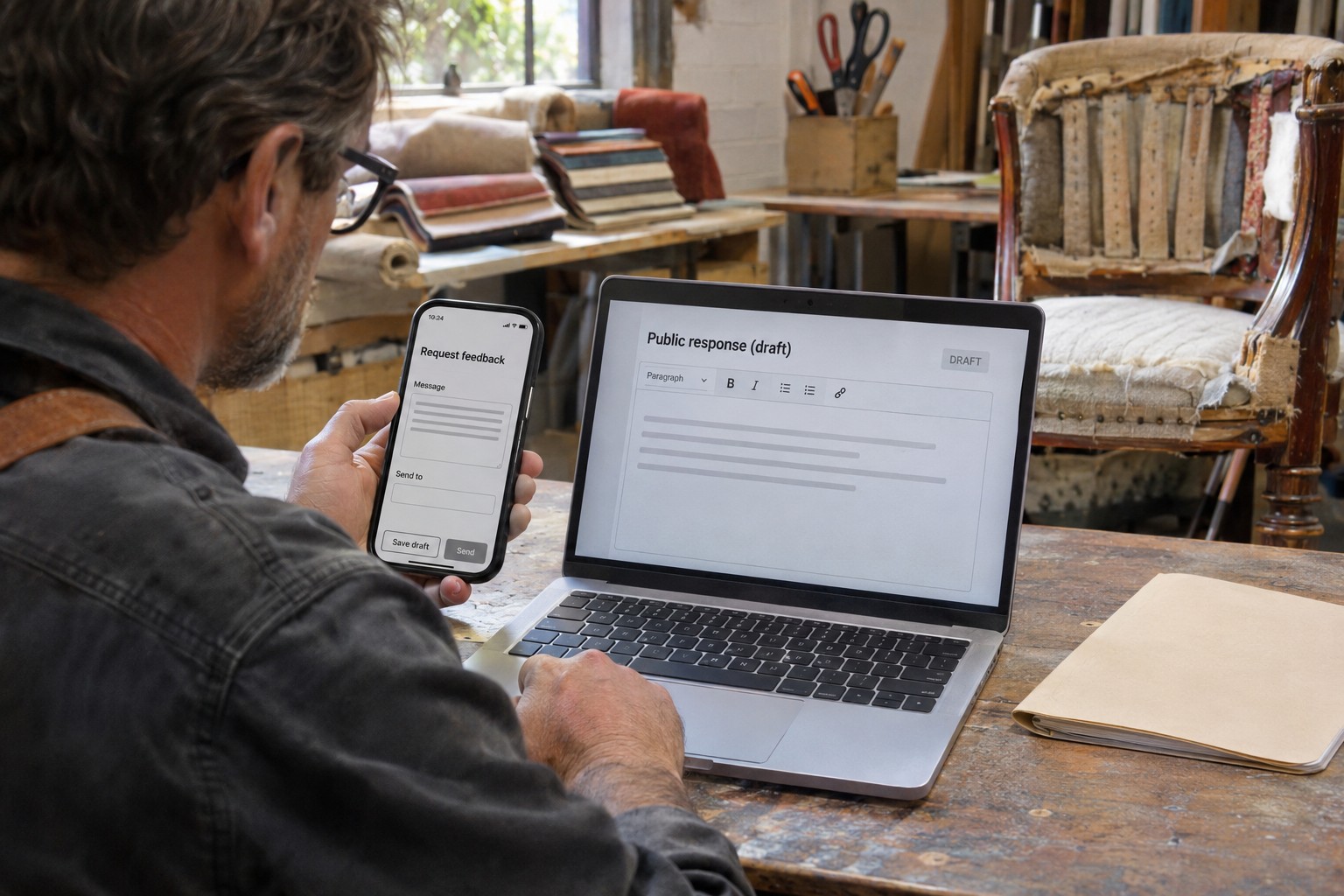
Define review requests, monitoring and reply approvals separately
Review requests, monitoring and written replies are different services. Your proposal should identify which are included, which platforms are covered and who approves a public response before it is posted.
Confirm the platform-specific request rules, who approves them and who may publish a reply. Monitoring a platform does not by itself establish that review requests will be sent there.
For your own business, ask the provider to demonstrate two things: an unhappy but otherwise eligible customer can receive the same neutral invitation as a happy customer, and a response writer cannot publish private details merely because they can see them. These checks make the approval arrangement concrete.
Give the request list a rule that does not depend on praise
Google’s review policy prohibits selectively soliciting positive reviews and offering incentives for reviews. A private satisfaction survey must not become a gate that sends only satisfied people toward Google. Choose the request audience using genuine customer experience and appropriate contact rules, not the rating you expect.
Consider a hypothetical Detroit upholstery shop. Two customers have collected completed jobs. Customer A privately praised the fabric finish; Customer B reported a delay. The shop, customers and workflow below are invented, not Guardian clients, a supplier’s actual process or a test we performed.
For this example, the owner proposes one neutral Google invitation after a completed job, only where the shop has established appropriate permission to use the selected contact channel. Existing opt-outs and prior sends are respected. The rule uses job completion, contact eligibility and invitation history. It does not use a satisfaction score, complaint flag or predicted star rating.
A and B therefore receive the same eligibility decision if their contact circumstances match. Staff can work on B’s service complaint privately without making its resolution a condition of access to a public-review invitation. If B has opted out of messages, do not send; record that restriction rather than labelling the exclusion “unhappy customer.” This is a proposed operating rule, not a statement that every customer must be contacted or that completing a job creates permission to text.
Illustrative request wording: “Thank you for choosing our shop. If you would like to share your experience, you can leave a Google review using our review link. We welcome honest feedback.” In a real configuration, add the verified review link for the intended business. Leave the rating and wording to the customer. A support contact may be available to everyone without making it a substitute destination reserved for dissatisfied people.
Four checks before any real request goes out
Ask for an authorized test using fictional records and a safe preview or controlled receiving arrangement. No public test review is needed. The following are expected results for the upholstery shop, not completed tests.
- Change the sentiment, keep eligibility fixed. Preview A and B with identical contact permission and invitation history. Both should receive the same invitation route. If changing B’s private feedback from “pleased” to “delay complaint” removes the Google link, stop the launch and correct that rule.
- Make a real contact restriction take priority. Use a third fictional record with an opt-out, then change its satisfaction field to positive. It must remain excluded. Check a duplicate job import too: the shop’s one-invitation rule should not send the same message again simply because the record was imported twice. Record the reason without exposing private notes in a shared report.
- Follow the actual destination. Open the proposed Google review link and any QR destination in the agreed preview. Confirm the business identity, not merely that a page loads. A link to a similarly named shop or an unapproved platform fails. Monitoring other platforms is not approval to request reviews there.
- Try to advance an unapproved reply. Give the response writer a fictional complaint and a draft containing a private order detail. The agreed workflow must keep it unpublished for the named approver to correct. If the product cannot enforce that separation, retain a manual approval and posting step or change the proposed setup before launch.
Keep the tested rule version, expected outcome, actual observation, unresolved issue and person accepting each check. A screenshot of the settings is not evidence that these examples behaved as intended. Agree who can pause requests and correct the configuration if later imports, changed contact preferences or a software update alter the behavior.
Work through one difficult reply without publishing the job file
Now suppose B independently posts that the upholstery work was late. The owner checks the private job record and confirms that completion missed the agreed date. The provider’s writer prepares a reply. In this fictional case, the owner is the factual approver; an authorized account manager posts only the version the owner accepts.
Google’s guidance on review replies says, “Never share a reviewer’s private information,” and recommends private contact for a complex concern. The record can inform the owner’s decision without being copied into the response. Leave out the customer’s contact details, order number, invoice, private messages and speculation about motives.
Illustrative response for the confirmed delay: “We’re sorry your upholstery work was completed later than agreed. Please contact our office through the contact details on our website so we can discuss the next step privately.” This example acknowledges the verified issue without inventing a refund, assigning blame or promising an outcome. The business must provide a working private contact route and someone able to handle the discussion.
Before approving that text, the owner answers four specific questions:
- Is the acknowledgment supported? Here, the owner confirmed the delay. If the facts are unresolved, revise the acknowledgment rather than let a writer guess or publicly accuse the reviewer.
- Does it disclose anything unnecessary? Remove private transaction or contact information even if it would help the business argue its side.
- Does it make a commitment? A refund, replacement or completion date requires separate authority and a factual basis. Do not offer a benefit in exchange for changing or removing a review.
- Who may post this version? Record the approved wording, approver and permitted publisher. An approval for one reply does not authorize every future response or a materially changed draft.
The private service case and the public reply then proceed separately. Resolving the service issue does not require the customer to revise their review. Equally, a posted apology does not establish that the underlying complaint has been resolved.
Google’s reply process requires a verified business and subjects replies to platform review before public posting; the reviewer is notified when a reply is posted. Record internal approval, submission and observed publication separately. Do not mark a saved draft as live or promise that an approved response will appear immediately.
Use the report to find unfinished work
The owner needs to see which request or response needs attention. Keep eligible records, excluded records with a suitable reason, attempted sends, delivered requests where confirmed, newly observed reviews, drafts awaiting approval and publicly observed replies distinct. Mark unknown delivery or publication states as unknown. A sent request does not establish receipt, and a received request does not establish a review.
In the example, B’s reply can be approved while publication remains pending. Its service case can still be open after the reply appears. Those two outstanding tasks have different owners and closing evidence. Reviewing that short exception list is more useful than treating a higher review count as proof that the process is working correctly.
Agree who may view the report and avoid attaching the private job file. Counts describe activity within the stated period and source; they do not prove additional sales, a cause of ranking changes or a promised rating.
Ask Guardian to scope the review work and the authority behind it
Guardian’s SEO service supports honest feedback requests without incentives or satisfaction screening and professional responses. Bring your public website and profile links, the request wording you use, the tools being considered and the role that can approve facts. Use invented examples to explain exceptions rather than sending customer records or passwords with the first inquiry.
The proposal should identify the request audience, platform coverage, contact-permission responsibilities, tools and access, drafting, factual approval, publishing and checks. Any automation or implementation must be confirmed separately. Our local SEO service scope is a useful related starting point; a review-monitoring inclusion alone should not be treated as authorization to send or post anything.
For evidence of the working relationship, the attributed Guardian client testimonials include Sam Kane and Rod Mench of Rod Mench Studios describing website work and an explanation of the process. That is a client-reported account of a different engagement, not evidence of a Detroit review campaign, a tested automation or future results.
A free website and SEO audit with a 30-minute consultation can help establish the starting point, with no purchase obligation. It does not configure messages or authorize access to private accounts. Discuss the review workflow your Detroit business needs and agree the work, responsibilities and costs before implementation.
Questions about review requests and public replies
Can we ask only customers who said they were happy?
For Google, do not screen invitations by satisfaction. Keep a private satisfaction survey from deciding who receives the public-review link. An unresolved complaint alone should not disqualify an otherwise eligible customer. Document legitimate contact restrictions, such as an opt-out, independently of sentiment. Apply the same rule when staff select recipients manually: removing the unhappy people from a spreadsheet creates the same problem as an automated satisfaction filter.
Can we offer a discount for an honest Google review?
Google prohibits incentives in exchange for any review, including one described as honest. It also prohibits incentives for revising or removing a negative review. Keep a genuine service remedy separate from that choice: do not condition a refund or repair on changing feedback. Ask whoever writes promotions to check this boundary too, so a coupon campaign does not undo the neutral request policy.
Does monitoring Google, Yelp and Facebook authorize the same request on all three?
No. The places a tool watches and the places it asks customers to post are separate settings and permissions. Have the supplier name each request destination and check its current rules before enabling that route. A service that requests Google reviews and monitors several platforms does not necessarily solicit reviews on every platform. Do not copy the Google example across destinations without that review.
What should a prelaunch review-request test cover?
Test the actual selection and send path, not just the message template. Include different sentiments with equal eligibility, a contact restriction, a duplicate record, the intended business link and a reply awaiting approval. Use fictional records and an authorized test destination or preview that cannot contact customers accidentally. Record failures and repeat affected checks after correction. Do not leave fake public reviews to prove that the button works.
Who approves a response when the facts are disputed?
Assign a person who can examine the relevant facts and has authority to speak for the business. The writer can propose wording, but should not decide that a customer is lying or invent a concession. Where the evidence is incomplete, use an accurate acknowledgment and a private inquiry route without asserting an unverified explanation. If the usual approver is absent, use an agreed substitute or keep the reply pending.
Can an automated reply include the customer’s order history?
Do not publish private order information to make a reply seem specific. The owner may need a restricted internal record to investigate, while the public writer needs only the facts approved for disclosure. Configure any drafting process accordingly and check its output before posting. A customer mentioning one detail publicly does not make the rest of the job file public. Move detailed resolution to the business’s appropriate private channel.
Does receiving a response draft mean the reply is live?
No. A draft, the business’s approval, submission to Google and public posting are separate events. Google reviews submitted replies, so internal approval does not guarantee immediate publication. Ask the permitted publisher to record the accepted version and check its public state when authorized. If the platform requests a change, return materially different wording to the approver rather than treating the first approval as permission for any replacement.
Can we remove a negative review because we disagree with it?
Disagreement alone is not a basis for a removal promise. If there is a specific Google content-policy concern, identify the relevant rule and use the platform’s reporting route; Google makes the decision. Keep a report of the review separate from the service complaint and proposed reply. Avoid public accusations or promises that a provider can erase criticism. A professional response may still be appropriate while the concern is considered.
Which numbers show whether the review workflow is operating?
Use a consistent reporting period and retain the meaning of each state: eligible, excluded, attempted, confirmed delivered, review observed, draft awaiting approval and reply publicly observed. Ask for exceptions as well as totals. A delivery count cannot show that every recipient read the message, and a new review cannot automatically be attributed to a particular request. Check outstanding approvals and contact restrictions before interpreting changes in ratings or sales.
Which review tasks can Guardian include?
Guardian’s documented SEO scope supports honest-request guidance and professional responses. Ask the proposal to name the tools, platforms, access, drafting, approval and publishing work actually included. Implementation and ongoing operation need explicit responsibilities rather than an assumption that monitoring buys both. We do not establish an included automated texting system, a response deadline or a removal guarantee here. Start with public links and invented examples, then arrange any necessary private access securely.