
Turn your Longmont website into a stronger marketing asset
Guardian Solutions helps Longmont businesses with ongoing SEO, website design and support for existing websites. The starting point is what you sell and who should find you, not a requirement to commission new photography or rebuild every page. Our Colorado Springs team works with clients remotely over Zoom.
Choose improvements that help customers make a decision
For a service business, that may mean separate, useful pages for its most valuable services, answers to common buying questions and a visible contact route. For a retailer, product categories, accurate descriptions and helpful images may need attention together. We review those needs against the website you already own so a focused improvement can be considered before a larger redesign.
- Search visibility: identify relevant search topics, strengthen internal links and address technical obstacles that affect important pages.
- Customer confidence: present the benefits, genuine project evidence and information a visitor needs before calling or requesting a quote.
- Usability: make service choices and inquiry options clear on mobile as well as desktop.
- Continuing improvement: define which SEO and content changes will be implemented, who is responsible and how progress will be reviewed.
An audit is a starting point, not a substitute for the work itself. A recurring plan should distinguish recommendations from completed changes and separate search visibility from actual customer inquiries. We can discuss organic improvements without requiring an advertising campaign.
Request a free website and SEO audit with a 30-minute consultation, or tell us what your Longmont website should accomplish. The image-planning guide below is an optional project consideration. It does not limit our services to product businesses.
A Longmont business can have the right product photograph for its website and still need a decision before sending that image to a dealer. A new advertising use raises a licensing question. A transparent cutout or larger print file raises a production question. Separate them before paying for an image change or adding work to the website proposal.
Guardian Solutions provides website design and support from Colorado Springs, with remote consultations over Zoom. Discuss the images and pages your Longmont website needs. Bring the intended website placements and any outstanding asset requirements; photography, licensing decisions and legal advice are not established as Guardian services by this guide.
Optional website consideration: preparing product images
Useful product images need both a suitable file and permission for the intended use. Confirm website placements, any third-party use and the production formats with the asset supplier. File preparation and usage permissions are separate questions: a cutout does not establish broader reuse rights, and a permission agreement does not create a print-ready file.
The hypothetical example below explains how to separate those decisions. Your actual agreement controls the permitted use; ask the rights holder or an appropriate adviser when the terms are unclear.
Work through the dealer request before forwarding the JPG
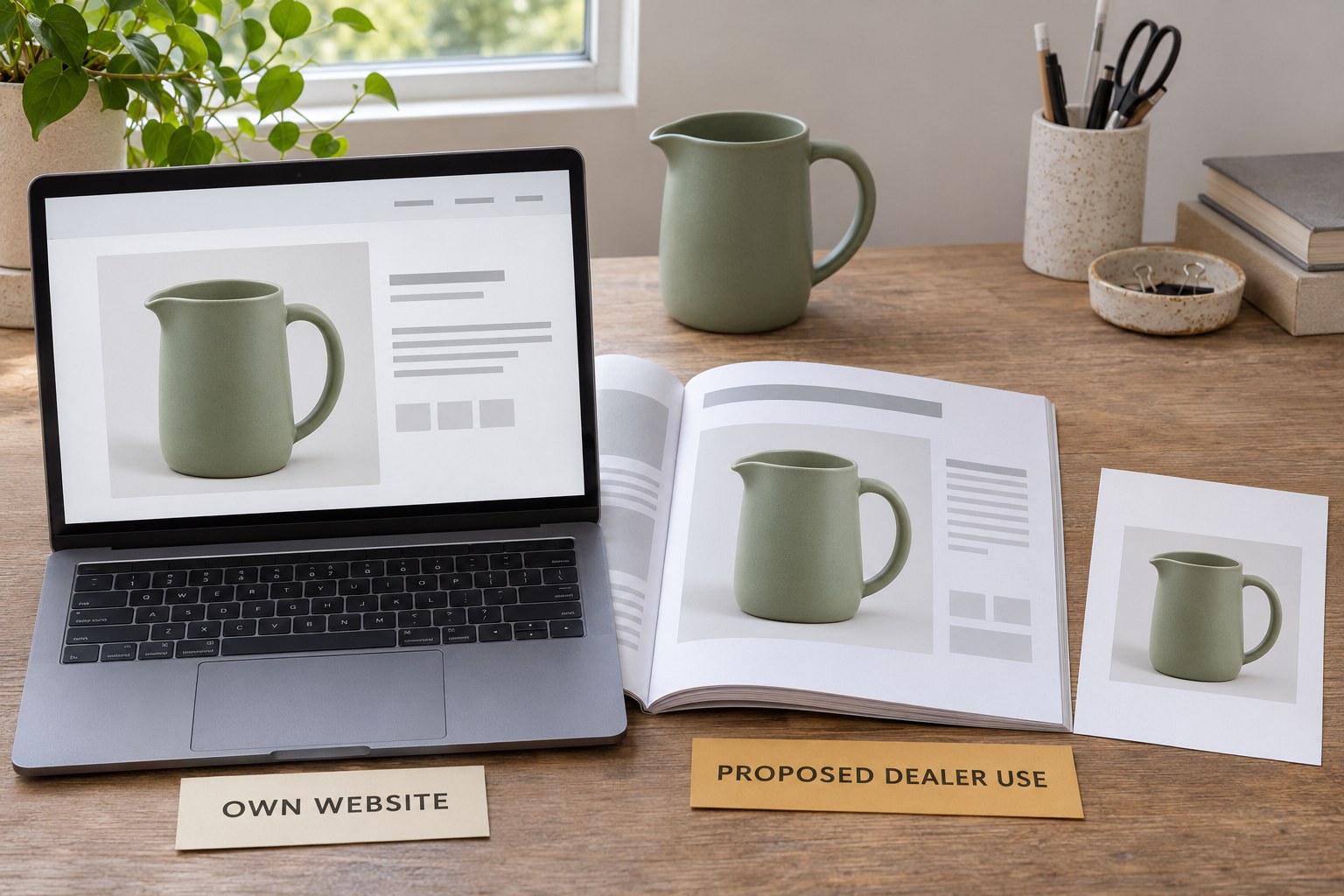
Imagine a Longmont maker selling a sage-green ceramic jug. In this hypothetical example, its written agreement confirms use of the product photograph on the maker’s own website. Later, a dealer asks for the same photograph for paid social advertising and a printed catalog. Dealer use was not identified in the original brief. This is an invented buying scenario, not a Guardian client, a real photographer’s contract or a claim about Longmont’s product market.
The maker should ask the photographer whether that proposed use is already covered, not announce that another license must be bought. Identify the actual third party and send a focused change request like this, adapted to the real agreement:
- Existing agreed use: our own product page, using the approved jug photograph. Identify the image filename and the agreement or estimate it belongs to.
- New request: the named dealer wants that image in its March–May 2027 paid social campaign and spring print catalog for its proposed Colorado distribution. These dates and market are illustrative requirements, not known license restrictions. Ask the dealer for placement, distribution and format details still missing.
- Evidence needed: written confirmation that the existing agreement covers this dealer and use, or the specific amendment required. Ask whether any term, territory, attribution or onward-use condition applies rather than inventing one.
- Production request: the dealer’s designer wants a product cutout and needs to confirm the final print dimensions. Please identify what can be supplied from the existing work and quote any additional preparation separately from licensing.
- Owner decision: keep the confirmed website use in place; do not release the image for the proposed dealer campaign until its coverage and required files are settled. Approve any extra cost and delivery date explicitly.
The request is deliberately about a change in users, media and deliverables. It does not ask a web developer to interpret a contract or treat possession of the JPG as permission. Where terms are unclear or contested, obtain appropriate legal advice before relying on an interpretation.
Choose the license work and production work independently
The photographer’s reply can lead to different purchases. Read the answer against the named image and proposed use, then make the decision with the dealer’s production requirements in view.
Existing coverage, usable file
If the licensor confirms the dealer campaign is covered and the designer accepts the existing file, retain that confirmation with the image reference. There may be no new license or production purchase. Pass along any applicable use conditions. The website need not change merely because the same approved image is used elsewhere.
Existing coverage, different production file
Suppose the campaign is covered but the designer needs a transparent background instead of the supplied white-background JPG. Ask for a suitable cutout deliverable, its format, revision allowance and price. Permission to use an image does not create a mask or remove its background. Equally, paying for those pixels does not by itself expand the permitted users or placements.
New coverage, with or without new production
If the agreement does not cover the proposed use, ask the licensor to describe and price the necessary extension. Keep any cutout, larger-file or retouching charge on its own line. Confirm the approved user, media and any applicable conditions in the resulting agreement. Do not budget a blanket “commercial upgrade” without knowing which use it buys.
If the revised cost or schedule does not suit the campaign, the owner can narrow or postpone the dealer use, or commission another asset cleared for that purpose. A different photograph still needs its own usable file and permission; calling it a replacement does not settle either. Keep the already confirmed own-site use separate from this unresolved campaign.
For the print proof, ask the designer or printer to confirm the needed dimensions, crop and output requirements. A 3000-pixel square delivery is not a promise that every catalog placement will work. Check whether the proposed crop hides a handle, label or other product detail. The accepted proof should show the actual product accurately, not merely fill the allotted space.
Commission only the website change that is actually needed
If the maker keeps the same approved product image and page, the dealer’s licensing discussion may require no website development. If the site also needs the new cutout, name the affected product page, gallery thumbnail and other placements in the website scope. Give the publisher the approved final file and its intended website use, then check the displayed product, crop and descriptive text on a phone and desktop.
Keep the full-resolution production master separate from the versions prepared for web delivery. Ask the website provider to choose suitable display dimensions and file weight while retaining the detail buyers need. A large print file is not automatically the right file to serve to every visitor. This is an implementation task to agree, not a reason to buy another license without checking the existing terms.
Guardian’s website design scope defines priority pages, content responsibilities, integrations, review rounds and launch checks. For an existing installation, discuss WordPress support or Joomla support. Confirm who supplies the final assets and who resolves the photographer’s outstanding questions before setting a release date.
Our website portfolio includes Sky Creek Homes as a home-builder website example, with project photography identified as a useful briefing topic. Use the presented work to discuss how images support a customer’s decision. It does not establish that Guardian took the photographs, owns the pictures or cleared a dealer campaign, and it is not a Longmont client example. Your project needs its own asset scope.
For the broader decision about explaining one service across a website and other channels, the Boulder content-scope guide addresses what the published pieces should accomplish. Here, settle the image-use change first. Bring Guardian the pages, approved assets and remaining production questions. The free website and SEO audit with a 30-minute consultation is a starting review with no purchase obligation, not image-rights clearance. Implementation and ongoing SEO need their own agreed scope.
Questions about product images in a website project
Does a commercial image license cover every future campaign?
Read the license issued for your project and ask the licensor to confirm an uncertain use. The word commercial does not establish either unlimited permission or a restriction on every new campaign. Identify the image, business using it and proposed placements. Keep the answer with the agreement so an approved website use is not mistaken for a decision about a later dealer promotion.
What changes when a dealer wants to use our product photographs?
A different business may be using the image in its own marketing. Give the licensor that business’s identity, proposed media and intended campaign details, then ask whether the existing agreement covers it. Do not assume own-site approval transfers automatically, or that an extension is always necessary. Agree who receives the file and any conditions the dealer must follow before forwarding it for the campaign.
Should we describe paid advertising before commissioning the photos?
Yes, describe the advertising you actually plan, including the users, placements and any still-uncertain parts. That helps the photographer estimate relevant usage and production rather than quote for a narrower brief. It does not establish a universal separate advertising fee. If you are considering a later campaign but have not selected its channels, identify that uncertainty and ask how a future scope change would be handled.
Are territory, duration and exclusivity always limited?
There is no universal answer for every image license. Ask whether those conditions exist in your agreement and what they mean for the proposed campaign. Supply the intended dates and markets as requirements, not assumed restrictions. If you need exclusivity, describe the actual competing use you want addressed and obtain a specific answer; a commercial-license label alone does not promise that arrangement.
Can we email the original JPG to our website designer?
Confirm that the designer can receive and use the file for the authorized production task, and tell them its intended placement and any applicable conditions. Ask whether the JPG meets the layout requirements before sending a batch. Preparing your website is a different purpose from using the photograph in the designer’s own advertising or portfolio. Do not silently treat a production handoff as permission for those additional uses.
Does buying a higher-resolution file extend the image license?
A larger deliverable and permission for additional use are separate things to confirm. Ask what pixel dimensions or other production changes the new fee buys, then check the proposed user and media against the license. A file can be technically suitable for a large placement without that placement being covered. Conversely, confirmed usage rights do not ensure the existing file meets a printer’s output requirements.
What if our website needs a cutout but the package supplies a square JPG?
Show the photographer or designer the intended layout and ask for the actual deliverable, such as a transparent image or a file with an appropriate mask. Confirm who performs the work, the output format, price and revisions. Do not ask only for a different filename extension. A license amendment does not remove a background, and the website provider should not assume editable layers arrive with a finished JPG.
Can we launch the website while the dealer campaign is unresolved?
Separate the uses. If the original website placement is confirmed and its assets are ready, discuss releasing that bounded scope while keeping the dealer campaign on hold. Name the person who obtains the remaining licensing and production answers, and do not send campaign files as though approval is complete. If the website itself depends on an unapproved use or missing deliverable, that affected part remains unresolved too.
Does a license extension include retouching when our product packaging changes?
Do not assume it does. The local product offer lists retouching, reshoots and revision cycles separately, except for its stated own-error exception. Describe the real packaging change and ask what production work is needed, alongside the intended use. Have the owner verify that the finished picture truthfully represents the current item. More permission does not alter the pixels, and an edit is not automatically an accurate replacement for a new photograph.
What should Guardian receive before placing the approved images?
Provide the final assets through the agreed delivery process, the pages and placements they belong to, confirmation of intended website use and any required credit or display condition. Identify who approved the product depiction and who answers unresolved licensing questions. Start the inquiry with public page links and a description of the work, without confidential contracts or passwords. Guardian’s implementation scope must be agreed separately from photography and rights decisions.