
Help Greeley customers find the right service and take action
Keeping a site available matters, but a working website also needs a clear offer. Guardian Solutions helps Greeley businesses plan SEO, digital marketing and website improvements around the services they want to grow. We provide this work from Colorado Springs with remote consultations.
Connect visibility, useful content and website usability
We can examine whether key service pages answer prospective customers’ questions, show relevant evidence and make contacting you straightforward. Our ongoing SEO services can address content and technical priorities, while website design can improve the layout and navigation that shape the visitor experience.
A practical plan distinguishes improvements intended to attract suitable inquiries from the maintenance needed to keep customer tasks working. Agree on deliverables, responsibilities and reporting rather than assuming that a monitoring tool supplies every kind of support. The monitoring example below explains that distinction in detail.
Discuss your Greeley marketing and website goals, whether you need a focused improvement or a broader ongoing plan.
For a Greeley business buying website care, ask what happens between a failed customer task and a verified repair. A monitor may check a page around the clock while human support follows a different schedule. Choose the customer action, alert destination and response coverage together, before relying on a monitoring badge.
Discuss your website’s support requirements with Guardian. We provide website support from Colorado Springs, with remote consultations over Zoom. Monitoring setup, incident investigation, repair and continuing coverage need an agreed scope; this page does not promise round-the-clock Guardian staffing.
A Northern Colorado offer separates monitoring from support
For a Greeley business, continuous website monitoring and staffed support are separate requirements. Define which systems are checked, who receives alerts and when a person can investigate. Guardian has security systems that monitor 24/7; human response and repair arrangements should be confirmed in the agreed service scope.
The page, reviewed November 11, 2026, also uses a general 48-hour request turnaround and an Authority priority-support item expressed as 24 hours. Its emergency FAQ specifies a four-hour business-hours response for Growth and Authority. Ask which wording applies to your selected plan and incident, how business hours are defined, and whether the commitment concerns acknowledgment, investigation or repair. Those phrases should not be combined into a new service guarantee.
This is one published offer, not an agency ranking, a complete market survey or evidence that a supplier failed a customer. Obtain the current written terms for your own website. The practical comparison is who acts on which problem and when, alongside what the software checks.
Give each check a condition and a limit
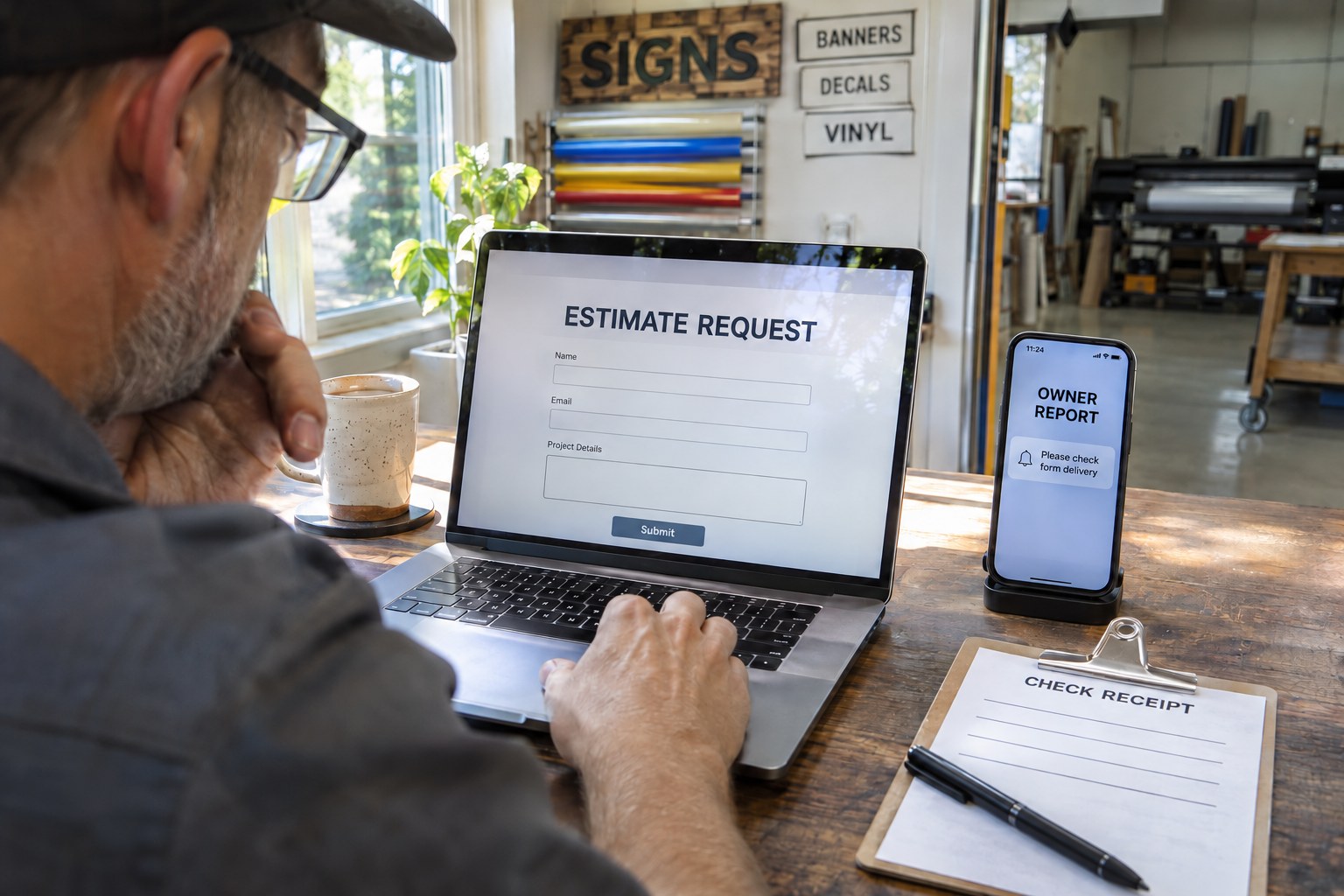
Start with the action your business most needs to keep available. For a commercial sign installer, that might be receiving an estimate request. A homepage check can be useful, but the proposal should identify what it observes before calling it coverage for the estimate process.
UptimeRobot’s keyword-monitoring documentation distinguishes a successful page response from checking for a particular word or phrase in the returned HTML. Its keyword check does not inspect content added only after JavaScript runs. These are product-specific capabilities, not evidence that Guardian uses that product. Finding a heading in page source does not establish that a submitted inquiry reaches staff.
For each proposed monitor, write down the exact URL or endpoint, check type, expected condition, frequency, alert rule and recipients, and functions it does not test. Ask the supplier to demonstrate the notification route in an authorized test. A configured recipient is not yet evidence that someone receives and owns the alert.
A modest starting scope can be one important public-page check, an agreed human report route and a responder with clear coverage. If a missed inquiry would justify a more involved automated journey test, discuss that separately. Such a test needs permission, identifiable sample records and controls over notifications, orders or other side effects. More frequent checks of the same heading would still leave downstream delivery untested.
Saturday example: the page passes, but the estimate is missing
Imagine a small Greeley sign-installation business with an estimate form. The business, times and observations below are invented. They are not a Guardian client or a test we performed. All times use the business’s local time. For this exercise, assume the purchased human-support coverage excludes Saturday and no separate on-call arrangement has been agreed.
- 10:00, the configured checks pass. The homepage returns the expected successful response, and its usual heading is present in the returned HTML. Those observations satisfy the two stated checks. Neither check submits the estimate form.
- 10:05, the owner learns of a missing request. A visitor reports submitting an estimate inquiry, but staff cannot find it at the agreed receiving destination. Record this as a reported delivery problem. It does not establish when the problem began, how many requests are affected or which component failed.
- 10:10, the owner reports the incident. The ticket identifies the form URL, observed time, expected destination and symptom, without attaching private customer details. An automatic ticket receipt can confirm that the report entered the system. It does not establish that a person has begun diagnosis.
- Next, check the actual coverage and fallback. Under this example’s assumed arrangement, a continuous page check does not create Saturday staffing. Record human acknowledgment as pending until it happens. Do not invent a Monday repair time. The owner needs the previously agreed temporary contact route, plus a person authorized to activate any customer notice.
Suppose the fallback is the business’s existing public office number, with an accurate explanation of when calls are answered. That can be a proposed alternative while delivery is investigated, but it needs the owner’s approval and someone able to publish it. Do not substitute an employee’s private mobile number or forward inquiries to an unapproved account. If nobody can make the notice during the uncovered period, record that gap before buying the plan.
The buying decision is now concrete. Can this business accept the uncovered period and operate its approved alternative, or does it need a separately confirmed response arrangement? Ask each supplier to price that requirement. A monitoring inclusion alone cannot answer it, and a small business does not automatically need the most expensive coverage.
Keep the ticket open until the affected task is checked
Use one incident record to connect the observation, responsible people and closing evidence. This proposed record continues the fictional Saturday example; the pending entries are deliberate.
- Affected task and observation
- Estimate submission to the agreed staff destination. Visitor reports a missing request at 10:05; the homepage checks passed at 10:00. Start time and wider impact remain unknown.
- Report and ownership
- Owner submits the report at 10:10 through the agreed channel. Record the notification recipient, backup contact and actual human acknowledgment time when known. Automated receipt and human acknowledgment have separate fields.
- Investigation and coverage
- Name the website investigator and the host, form-service or mailbox contact needed at each boundary. Record applicable staffed hours, any accepted extra work and the next update promised. Diagnosis and repair are pending in this example.
- Temporary customer route
- Owner-approved office contact and truthful availability wording, if usable. Record who can publish it, whether it is actually live and when it will be reviewed.
- Closing evidence
- After an agreed repair, repeat the affected inquiry with an authorized, clearly marked sample and confirm its receipt at the intended destination. Record the tested URL, time, sample identifier, observed result and confirming person. No closing test has been performed here.
- Remaining issue
- Record unresolved dependencies separately. A successful new test does not account for earlier missing inquiries or prove that the same fault can never recur.
The investigator might locate the problem in the form, website mail generation, delivery service, filtering or receiving workflow. The symptom alone cannot choose the fix. Agree who coordinates the handoff when another provider must act, and who returns with the next update. A host reporting that the server is available leaves the form-delivery question open.
For the closing test, use a consenting receiving arrangement and a unique sample label. Check the information staff need to identify an estimate request, then mark the sample as a test so it does not start sales follow-up. If the form displays success but the sample is absent at the agreed destination, the delivery check remains unresolved. A screenshot of the homepage cannot close it.
Afterward, review whether a better signal or clearer alert ownership would have helped. Change the monitoring scope only with the necessary permissions and costs agreed. Keep any investigation of earlier missing requests separate from the evidence that new delivery works.
Ask Guardian to scope the investigation and the response separately
Guardian’s WordPress support starts with the affected visitor action and relevant dependencies. Its form guidance calls for a coordinated, distinguishable test checked at the receiving destination. For a Joomla installation, use our Joomla support route. Confirm the platform, access and outside-provider responsibilities before relying on a repair quote.
Bring the public URL, the important customer action, symptoms and times, known providers, and the support wording you are comparing. Keep passwords, mailbox contents and private customer records out of the initial inquiry. Ask the proposal to identify check setup, alert handling, staffed coverage, investigation, repair, verification and any separately charged work. Published contact hours and support routes are not a response-time or resolution-time guarantee.
Our website portfolio includes Hartshorn Carpet Cleaning & Restoration as a home-services website example. It is useful for discussing service presentation and the customer contact path. It does not establish a Greeley monitoring deployment, current operation of that client’s forms or a staffed incident-response service.
The free website and SEO audit with a 30-minute consultation offers a starting review with no purchase obligation. It does not configure a monitor, reserve emergency labor or verify a private receiving system. Those tasks require their own scope. Discuss the coverage your Greeley website needs before treating an automated check as a complete support plan.
Questions about website monitoring and incident response
Does 24/7 website monitoring include a person fixing problems at any hour?
Only if the agreement separately provides that staffing and work. Ask for automated-check coverage, staffed support hours, timezone, holiday treatment and the handling of reports outside those hours. With Guardian, the actual monitoring and response scope must be confirmed. A running check does not reserve a technician.
Which page or customer task should we monitor first?
Choose the action whose interruption would matter most to your business, then identify the smaller observations a check can make. For the sign installer, receiving an estimate is the business task; a homepage response is one limited observation. Ask what the proposed check misses and how a person reports those failures. Start with a useful, maintainable scope rather than adding every URL without an alert owner.
Can the website be up while the contact form is broken?
Yes. A successful page response can coexist with a problem during form submission or later delivery. A text check can confirm a heading exists without sending an inquiry. UptimeRobot’s described keyword check reads returned HTML, not JavaScript-only content. For your chosen setup, identify exactly what runs and what it proves. Keep the reported form symptom open until the agreed customer action and destination have been checked.
Who should receive website alerts when the usual contact is away?
Name a primary recipient, an absence cover and the person responsible for escalation. Confirm their coverage and test that the approved notification route reaches them. Consider whether the alert relies on the same email or website service that could be unavailable. Arrange a suitable alternative if needed. Keep private contact details and credentials out of public status pages; receiving an alert need not require full website-administrator access.
What is the difference between response time and resolution time?
Response may mean acknowledgment or starting investigation, depending on the agreement. Resolution concerns restoring the defined function and verifying it. Ask which event starts each clock, what hours count and how outside-provider dependencies are handled. An automatic ticket receipt is another event, not proof of human work. Record those times separately instead of converting an advertised response interval into a guaranteed repair deadline.
How should planned maintenance and repeated false alerts be handled?
Agree the affected checks, notice, responsible person and start and end of any planned suppression. Confirm monitoring resumes and the relevant function works afterward. For repeated alerts, have the provider investigate the condition and notification rule before changing thresholds. Keep any change and resulting blind spot documented. Silencing alerts indefinitely may hide a real interruption; a quiet inbox alone is not evidence that the website is healthy.
What should happen outside the supplier’s staffed support hours?
Follow an arrangement agreed before the incident: who receives the report, whether anyone is on call, what work they may authorize and which customer alternative is available. If coverage is absent, state that honestly and decide whether the business can tolerate the gap. A fallback needs a reachable destination and an authorized publisher. Do not promise the next repair time from business-hours wording alone.
How can a form-delivery check avoid creating real customer work?
Arrange the test with the website owner and receiving team, use invented details and a unique test label, and agree how the sample is excluded from sales follow-up. Identify any automated emails, CRM tasks or other downstream effects before submitting. Use supported test arrangements where available. An ongoing synthetic journey needs its own permissions and maintenance; an ordinary page monitor does not authorize repeated public-form submissions.
What evidence is enough to close a form-delivery incident?
Repeat the affected path after the agreed change and verify the marked sample at the intended receiving destination. Keep the URL, time, sample identifier, result and person confirming receipt. If another system or recipient cannot be checked, leave that limit visible. New delivery working does not establish what happened to earlier requests, prove permanent prevention or guarantee every future submission. Record any remaining investigation separately.
Which responsibilities belong to Guardian, the host or the form provider?
Name the party able to investigate and change each part: website application, hosting, outside form service, delivery service and receiving account. One provider may cover several parts, but that needs confirmation. Ask who coordinates an unresolved handoff and who verifies the complete task afterward. Guardian can assess website support within agreed scope; hosting, routine care or a free audit should not be assumed to include every integration or emergency response.