
Aurora SEO and website services that help customers find your business, understand your offer and take the next step. Start with a practical plan from Guardian Solutions.
SEO and website marketing for Aurora businesses
Your website should connect the services you want to sell with the questions customers ask before contacting you. Guardian Solutions helps Aurora businesses with search engine optimization, website design and ongoing website support. You do not need a multilingual website to work with us; language-specific content is one optional requirement, not the limit of our services.
Build a complete organic lead-generation path
Start with your priority services and the areas you actually serve. We can assess whether each important service has a clear page, useful answers, relevant internal links and an easy inquiry route. A local SEO scope can also address the consistency of your business information and the connection between your Google Business Profile and website. Agree the work to be implemented, not just a list of audit findings.
For an existing site, separate technical obstacles from content and conversion improvements. Repairing crawlable links or confusing navigation serves a different purpose from explaining why a customer should choose you. A recurring SEO plan should identify the priorities, who makes each change and how progress will be reviewed. Advertising is not required to begin this organic work.
Request your free website and SEO audit. Bring your website address, most valuable services and examples of the inquiries you want. We will discuss the next steps with you from our Colorado Springs base, including remote consultations. The practical language example below is relevant only if your customers need it.
Guardian Solutions provides website and SEO support from Colorado Springs, with remote consultations over Zoom. Request a free website and SEO audit with a 30-minute consultation to discuss your current site. There is no purchase obligation. Translation, fluent-language review and implementation are separate responsibilities to confirm; the free review does not certify a translation.
Optional website requirement: reviewed language versions
For an Aurora business planning a language version of its website, Guardian can help define the implementation work: approved service pages, form labels, error messages and customer acknowledgments. Agree which content needs translation and who will review its meaning before development begins. A language used in a campaign is not, by itself, a complete website specification.
A useful local distinction appears in the City of Aurora’s translation disclaimer. It explains that its automated translations are approximate, some content may remain untranslated and some applications may not work as expected. That is the city’s stated limit for its convenience feature, not a finding that its site is broken or that every translation tool fails.
For a business, the question is which meaning and actions need approval. The service exclusion a customer relies on, the form they submit and the reply they receive deserve review together. Use actual customer requests and your ability to respond to choose the first language. A person’s name, neighborhood or ethnicity is not evidence of their preferred language.
Work through one furniture-repair inquiry in two languages
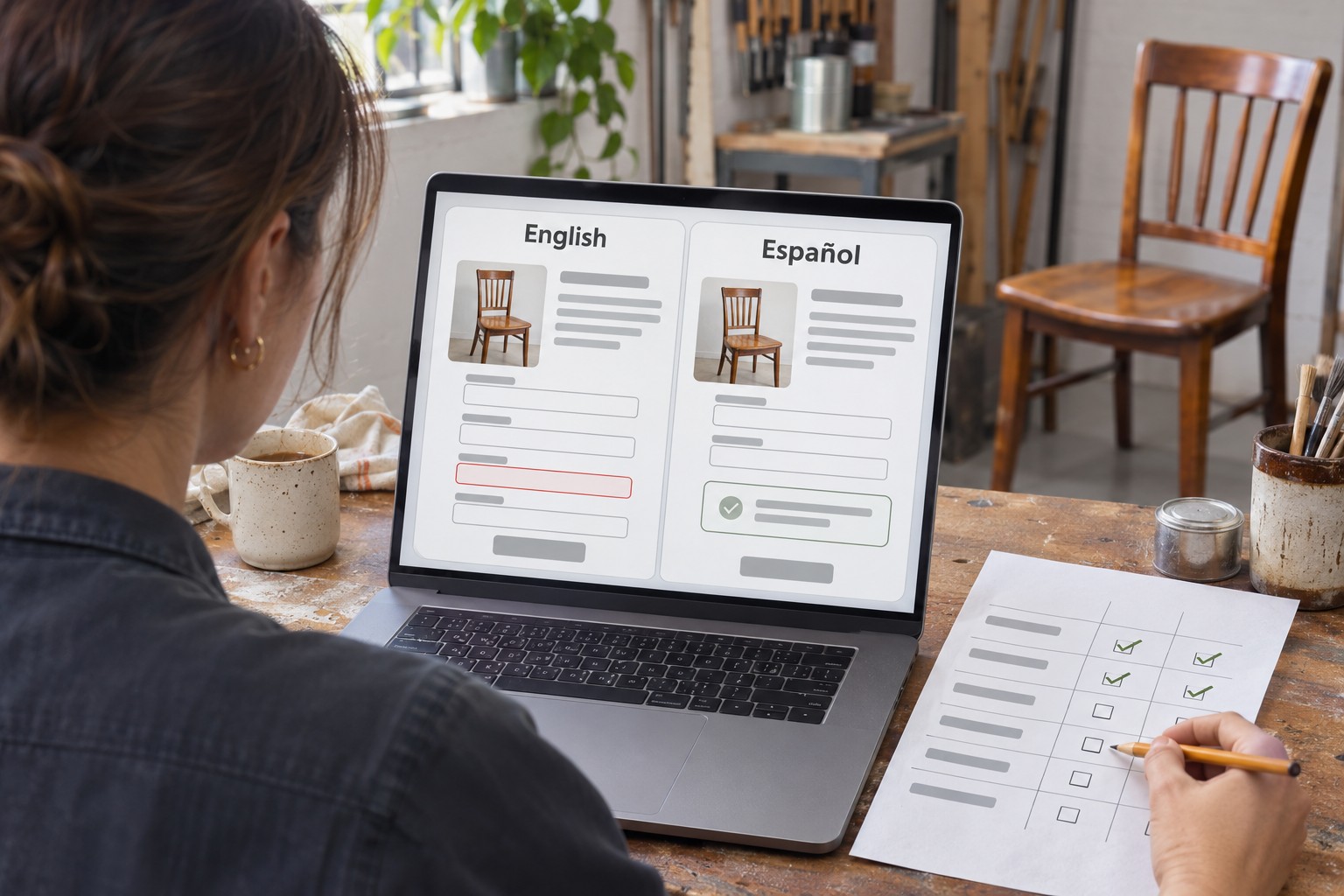
Consider a hypothetical Aurora furniture-repair business. In this invented scenario, customers have requested Spanish information, and the owner has arranged both a fluent reviewer and someone who can answer Spanish inquiries. These are assumptions for the exercise, not findings about Aurora customers, Guardian staffing or a completed client project.
The owner chooses one task: ask whether a loose wooden chair can be repaired. The business repairs wooden furniture but does not do upholstery. Photos help staff decide what to ask next; a firm repair quote requires inspection. The first translated scope follows that task through four stages.
1. Explain the same offer
The English and Spanish service versions must communicate the accepted repairs, upholstery exclusion and inspection-before-quote condition. Give the translator the owner-approved explanation and a short terminology note, including what the business means by repair versus refinishing. The owner settles the offer; a qualified language reviewer checks its meaning. The developer places the approved content without inventing missing terms.
2. Include the states people see when something goes wrong
For this example, the inquiry asks for a name, reply email, furniture type and description of the problem, with an optional photo. Include the field labels, help text, required-field instructions, upload restrictions, missing-email error and upload-failure message in the translation assignment. Confirm the actual file rules with the website provider before writing them.
Ask the reviewer to leave the reply email blank, then try an unsupported image type in an agreed test. They should understand how to correct each problem without losing the description already entered. A successful submission alone would never reveal either error message.
3. Make receipt and follow-up mean the same thing
The on-screen acknowledgment and any customer email should say the inquiry was received for review. Neither should imply a repair has been accepted, an inspection booked or a price fixed. Include the relevant message templates in scope, even if another service sends them.
The designated responder then reads a clearly marked test inquiry and prepares the agreed next reply in the chosen language. Check that they receive the description and language preference needed to respond. If nobody can provide that reply, change the promised support before publishing the language option. Software translation does not create customer-service capacity.
4. Keep the language choice connected to the repair
A visitor switching languages from the chair-repair explanation should reach its corresponding version, not an unrelated homepage. From the form, provide a way back to that same service explanation. Agree what happens to information already typed if a visitor changes language, and test that behavior rather than assuming it is preserved.
Google’s multilingual-site guidance recommends distinct URLs for different language versions and explains how to identify those variants. It also warns that dynamically switched versions may not all be discovered and crawled. Have the developer assess the URL and language-link implementation for the actual site. This is a technical scope question, not a promise of indexing or search traffic.
A translation can read well while the inquiry still fails
Have a fluent reviewer perform the same chair-repair task in each language on a phone and desktop. Keep a short acceptance record with the starting URL and version, task, expected meaning or behavior, observed result, correction owner and retest result. Use invented inquiry details and coordinate any submission with the receiving team.
One completed record in this hypothetical test could read: “Spanish service page, version 1. Ask about a wooden chair, leave the reply email blank, then correct it and submit. The missing-email instruction remains in English; the final acknowledgment is translated. Website developer to connect the reviewer-approved error text; fluent reviewer to repeat the failed-field test.” The translated acknowledgment passes its check. The error instruction remains unresolved.
Now suppose the photo form opens an outside quote tool that returns to English. Identify that exact boundary and ask its provider about supported language settings and editable messages. If it cannot support the required path, discuss a reviewed inquiry alternative or clearly state the limitation before the link. Do not mark the whole journey complete because the surrounding page is translated.
Finally, test a material change. The owner adds veneer repairs to the excluded work in version 2. The language reviewer approves the matching meaning in both service versions, and the publisher checks the related form help and reply template for contradictory wording. Record both approvals and the released versions. A draft translation waiting in an inbox does not update the public offer.
Bring Guardian the journey, the approved meaning and the open questions
Send the service URL, the language customers have requested, the current inquiry destination and any outside tool involved. Identify who can approve the business facts, review the translation and answer inquiries. A redacted or invented example can explain the problem without sharing private customer messages or account credentials.
Guardian’s website design scope can define pages, content responsibilities, forms, integrations and launch checks. For an existing installation, discuss WordPress support or Joomla support. Ask us to assess the structure and implementation of supplied, approved content. Specialist translation, fluent review, legal wording, language-switch behavior and customer response arrangements must each be confirmed before they are included in a proposal.
If you need business advice in another language, the city-hosted Aurora-South Metro SBDC describes English and Spanish advising with translation support in other languages. That is a local business-support route, not evidence of commercial website translation or Guardian’s language capabilities. Confirm the assistance you need directly.
Discuss your Aurora website’s language requirements with Guardian. Start with one complete service-to-inquiry path and agree the remaining responsibilities before expanding it.
Questions about multilingual business websites
Which language and service page should we translate first?
Use the language requests your business actually receives, the service involved and your capacity to answer. Ask customers their preference rather than inferring it from a name or address. Start with one useful service and its complete inquiry path. Search estimates for “web design Aurora CO” do not establish Spanish demand, and a citywide language statistic would not identify the needs of your own customers.
When is a website translation button not enough?
When a customer must rely on a condition to decide whether to buy or inquire, arrange review of that meaning and the steps that follow. Check exclusions, quote conditions, errors and acknowledgments in context. Aurora’s disclaimer illustrates that an automated convenience feature can have stated limits. It does not establish that your chosen tool is unsuitable; test the actual task and decide which content needs an approved language version.
Does Spanish SEO or advertising include a translated website form?
Only when the proposal says so. A campaign description does not enumerate the page and form states for your website. Give the provider the destination URL and ask which labels, errors, confirmations and linked pages will be reviewed and implemented. Also identify who handles the replies. Campaign writing, website implementation and customer communication are separately identifiable work.
Who approves translated service terms and exclusions?
The business owner or responsible service lead approves what is offered. A qualified translator or fluent reviewer checks whether the other-language version conveys that same meaning, including exclusions and uncertainty. Keep agreed terminology with the source text so revisions are consistent. The developer implements the approved material and fixes display problems. Legal terms or regulated claims need appropriate specialist review rather than approval by a website editor alone.
Which form messages belong in a multilingual website quote?
Include field labels, instructions, required-field notices, validation errors, upload restrictions, failure messages, success screens and any customer-facing email. Identify which system supplies each one. Ask for tests with a missing required field, an invalid entry and a permitted submission using invented details. A translation file containing only the labels does not demonstrate that a visitor can recover from a mistake or understand what was submitted.
What if the quote tool or linked PDF is only in English?
Make that boundary visible before the visitor enters it and determine whether it prevents the task. Ask the tool owner about supported languages and the document owner about an approved translated version. If an essential condition exists only in the PDF, the surrounding translated page is incomplete for that decision. Agree an alternative or a clearly limited scope; do not claim that an external system was translated by changing the link text.
How should visitors switch languages without starting over?
Link corresponding service versions and keep a clear route back from the inquiry to the relevant explanation. Before promising that entered information will survive a switch, test it in the actual form. Where it cannot be retained, explain that before the visitor changes language. Use language names rather than flags alone, and have a fluent reviewer check the labels. Automatic browser-language detection should not be the visitor’s only way to choose.
Can we offer a Spanish page if our team replies only in English?
Be explicit about the response language before someone submits. A translated page does not justify a “Spanish support” claim. Decide whether you will arrange a suitable responder, provide a limited information-only version or explain the English-only follow-up. Have the language reviewer check that explanation too. Do not promise an interpreter, translated acknowledgment, response deadline or ongoing bilingual service that the business has not actually arranged.
How do we keep prices, exclusions and availability consistent across languages?
Give each material change one owner and identify every approved version it affects, including forms and message templates. Have the business approve the new fact and the language reviewer approve its meaning before release. Compare the public versions afterward and retain the revision record. If one translation is delayed, agree an accurate temporary explanation or pause the affected offer; do not quietly leave a superseded price or exclusion as current.
What can Guardian assess before we commission translation work?
Bring the current service page, target language, inquiry route, platform and outside-tool names, plus your proposed factual approver, language reviewer and responder. Guardian can discuss website structure, supplied content and the implementation scope. Confirm translation, specialist review, message handling and maintenance separately. The free audit is a starting website review, not proof of bilingual staffing, complete language support or compatibility with a particular translation product.