
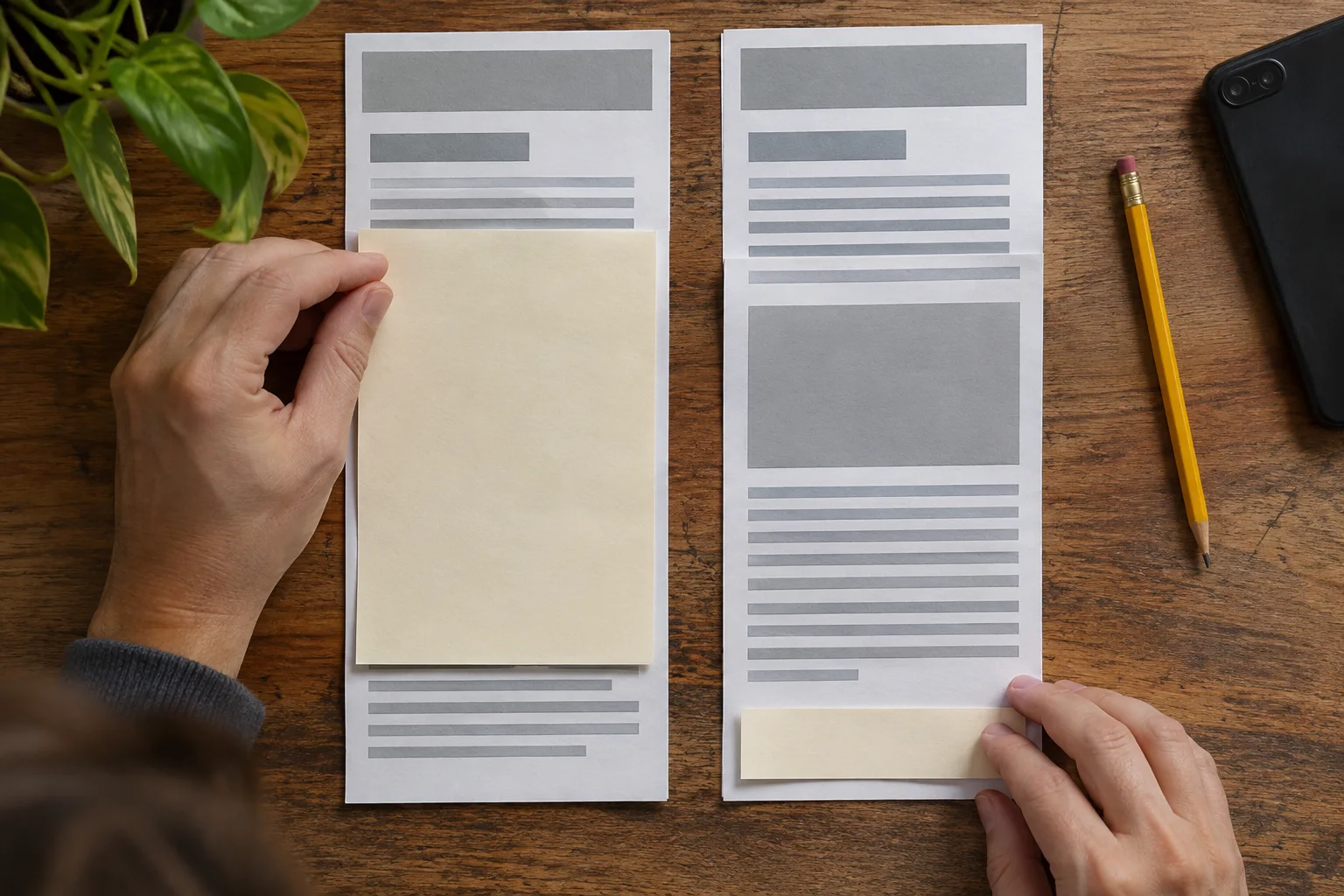
The first screen a customer sees should help deliver the reason they opened the page. When an overlay covers most of the answer, the visitor must solve a different problem before learning about the service. Review that interruption as part of the customer journey.
Reconstructed archive: August 2016. Written in November 2026 using contemporary historical sources. The archive date organizes this series; this text is not a recovered original.
The August 2016 announcement
On August 23, 2016, Google announced a broader mobile-content accessibility signal planned for January 2017. It discussed intrusive interstitials and examples of reasonable uses. This was an expansion beyond earlier app-install guidance, with context and exceptions that matter when interpreting the historical announcement.
Earlier context: app-install interruptions in September 2015
Google's September 1, 2015 announcement addressed large app-install interstitials that covered much of the content someone expected after opening a search result. That narrower scope preceded the broader August 2016 guidance and its planned January 2017 signal. Neither historical announcement is a reason to treat every necessary notice as an optional promotion.
List the interruptions that can appear together
Promotions, chat invitations, signup requests, and other notices may be managed by separate tools. Review the combined sequence on a phone. Several independently approved components can still create an overwhelming first visit when nobody checks how they interact.
Test an ordinary entry page
Start from an important service or article destination, rather than only the homepage. Check the complete prompt sequence on a phone, then repeat using keyboard controls. Can a visitor reach and operate an optional promotion's close control without a pointer? If it is a modal dialog, check that focus enters it, remains within it while open and returns to the initiating control or another logical place when dismissed. Check Escape dismissal where appropriate to that dialog's purpose. The W3C modal-dialog pattern explains the expected focus behavior. Retain required notices and their necessary choices; test their usability rather than removing them. Repeat after major promotional or template changes.
Include the space an overlay consumes and whether its dismiss control remains understandable on a phone. Record the entry URL, device, prompts shown, whether the promised content remains reachable, the dismissal steps, the next customer action and the retest result. An illustrative failure is a readable service page whose promotion hides the contact control after a second prompt appears. Fix and retest the combined sequence rather than approving each tool separately.
Keep the purpose clear
A necessary notice and an optional promotion have different jobs. Discuss each implementation under current relevant guidance. Do not use a historical announcement to justify removing essential information, and do not treat an optional sales prompt as essential merely because a tool can display it.
Measure the complete outcome
A rise in popup interactions does not by itself prove the site is helping more customers. Review whether visitors can understand the service and reach a suitable next step. The enduring lesson is to make access to useful content part of the decision about every mobile interruption.
Explore website design, digital marketing strategy, or contact Guardian Solutions to discuss your next step.
Historical source: Google announcement dated 2016-08-23.